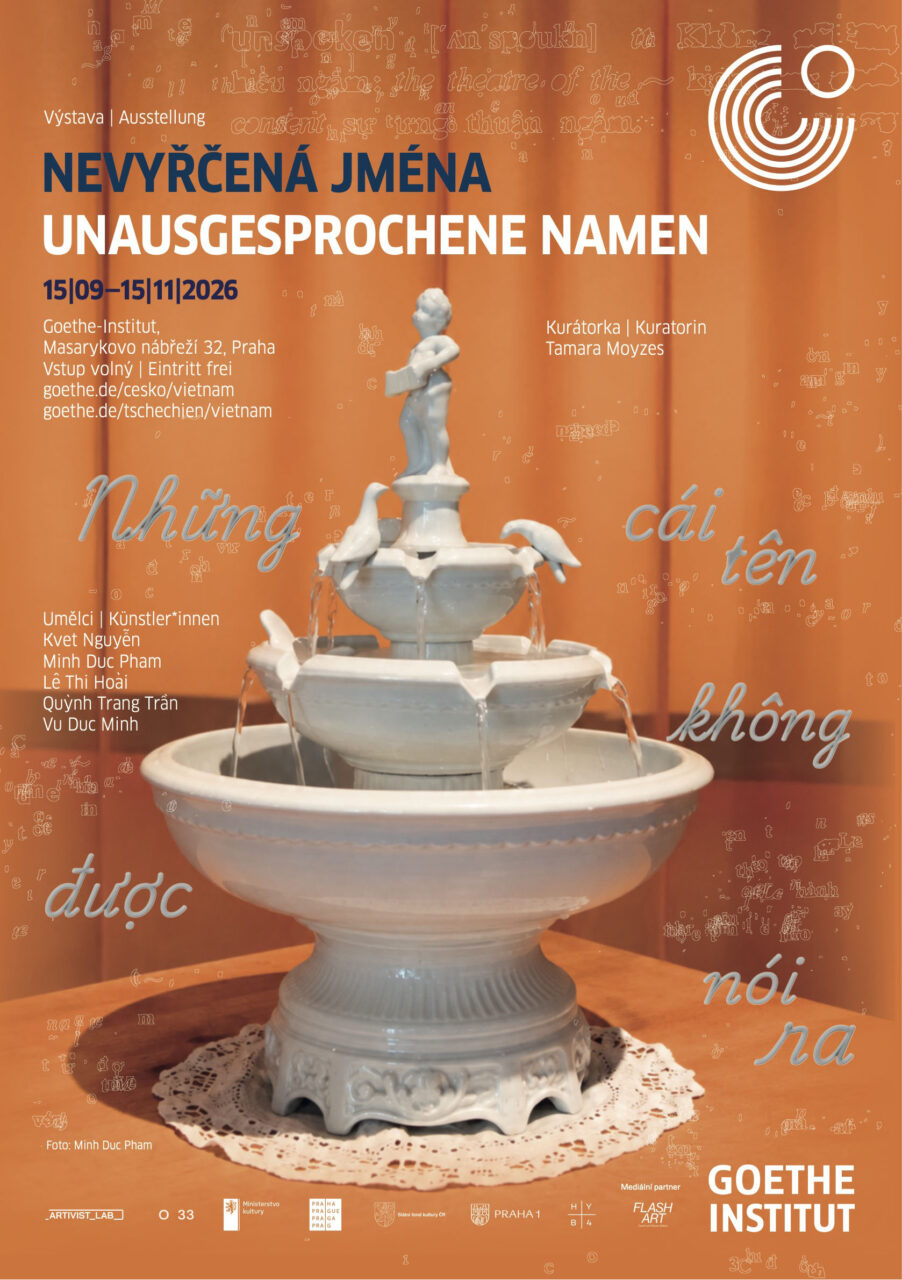
Paměť vietnamské diaspory v postsocialistické Evropě
Umělci a umělkyně: Lê Thị Hoài (CZ), Quỳnh Trang Trần (CZ), Kvet Nguyễn (SK), Duc Minh Vu (CZ/DE), Minh Duc Pham (DE)
Vernisáž: 15. září v 18:00 hod.
Termín výstavy: 15. září až 13. listopadu 2026
Místo: Goethe Institut, Masarykovo nábřeží 32, 110 00 Nové Město, Praha
Kurátorka: Tamara Moyzes
Produkce a doprovodný program: Adrian Leo, Isabella Petzold, Klára Arpa, Martin Zavoral, Tomáš Moravec
Výstava Nevyřčená jména / Unspoken Names / Unausgesprochene Namen představuje tvorbu umělců a umělkyň vietnamského původu, jejichž osobní, rodinné a umělecké historie se prolínají s postsocialistickými dějinami střední a východní Evropy. Česká republika, Slovensko a Německo zde nejsou nahlíženy jako oddělené národní rámce, ale jako historicky propojená prostředí, v nichž se vietnamská diaspora utvářela prostřednictvím pracovních dohod, studijních pobytů, socialistických příslibů, migračních režimů, rodinné paměti a zkušenosti společenské neviditelnosti. Výstava sleduje, jak se tyto dějiny zapisují do obrazů, archivů, objektů, zvuků a každodenních gest, jejichž prostřednictvím se utvářejí vztahy k domovu, paměti a sounáležitosti.
Obraz zde není pouhou ilustrací minulosti, ale aktivním médiem paměti a svědectví. Fotografické, filmové a další vizuální záznamy realitu nejen zachycují, ale také ovlivňují, jaký vztah k ní společnost zaujímá a které události uchovává ve své paměti (Sontag, 1977). Obraz proto ve výstavě nevystupuje pouze jako dokument, ale také jako místo, v němž je minulost znovu zpřítomňována, interpretována a předávána dál.
Projekt vychází z předpokladu, že paměť vietnamské migrace není okrajovou kapitolou českých, slovenských či německých dějin, ale jejich součástí. V období socialismu přicházeli lidé z Vietnamu do Československa a Německé demokratické republiky v rámci pracovních, vzdělávacích a politických dohod. Tyto formy mobility však nelze chápat pouze prostřednictvím dějin smluvní pracovní migrace. Zahrnovaly také studenty, umělce a další odborníky, kteří přicházeli v rámci vzdělávacích programů, stipendií a kulturních výměn. Vietnamskou přítomnost v socialistické Evropě tak utvářely různé formy mobility, od práce a studia až po uměleckou a intelektuální výměnu, zasazené do širšího politického projektu socialistického internacionalismu.
Tyto formy mobility byly oficiálně rámovány jazykem solidarity, internacionalismu a hospodářské spolupráce, zároveň však probíhaly v prostředí poznamenaném hierarchiemi, institucionální kontrolou, omezenou mobilitou a nerovným zacházením. Politické a administrativní struktury regulující mobilitu mohly hluboce zasahovat do soukromého života a určovat nejen to, kde lidé mohli žít a pracovat, ale také podmínky intimního a rodinného života a v některých případech i reprodukční autonomie. Po pádu socialismu dřívější rétoriku solidarity v mnoha případech vystřídala nejistota, administrativní tlak a sociální vyloučení. Druhá generace českých, slovenských a německých Vietnamců a Vietnamek dnes tuto historii nenese pouze jako vzpomínku na migraci svých rodičů, ale také jako vlastní zkušenost dospívání mezi jazyky, kulturami, představami o domově a společenskými očekáváními.
Název výstavy odkazuje ke způsobům, jimiž vietnamská jména často nebyla v české, slovenské a německé společnosti přijímána jako samozřejmá součást sdíleného veřejného prostoru. V různých společenských a institucionálních kontextech se Vietnamci a Vietnamky setkávali s tlakem svá jména zjednodušovat, přizpůsobovat nebo nahrazovat českými či německými jmény. Název zároveň poukazuje k širší absenci, k dlouhodobému vytěsňování dějin vietnamské diaspory z veřejné paměti.
Výstava se ptá, čí jména byla vyslovována v oficiálních archivech a čí zůstávala umlčena. Které příběhy byly začleněny do národní paměti a které byly vytěsněny do rodinných alb, komunitních archivů, tělesné paměti, zvukových stop či nevyslovených mezigeneračních rozhovorů? Paměť zde není chápána jako souvislé a uzavřené vyprávění o minulosti, ale jako práce s fragmenty, stopami a obrazy dějin, které se stávají čitelnými až v určitém historickém okamžiku (Benjamin, 2003). Vzpomínání proto není pouhým návratem k tomu, co bylo ztraceno. Může se stát také způsobem, jak z perspektivy přítomnosti znovu promýšlet politické přísliby a selhání minulosti a ptát se, jaké nenaplněné možnosti mohou tyto dějiny stále obsahovat. Archiv proto není neutrálním úložištěm faktů, ale prostorem moci, výběru, pozdějšího rozpoznávání a nového čtení.
Tento přístup souvisí také s otázkou technických obrazů a mediálního zprostředkování paměti. Obrazy nejsou pouze odrazem světa, ale strukturují naše vnímání reality a podílejí se na tom, jak společnost organizuje viditelnost, význam a komunikaci (Flusser, 2000).
Fotografie, video, zvukové nahrávky a archivní materiály proto ve výstavě nevystupují pouze jako dokumenty minulosti. Stávají se prostředky, jejichž prostřednictvím je nově formulován vztah mezi osobní zkušeností, komunitní pamětí a veřejným prostorem.
V širším společenském smyslu lze výstavu číst také ve vztahu k modernitě, jinakosti a nejistotě. Moderní společnosti vytvářejí kategorie příslušnosti a odlišnosti, které určují, kdo je považován za samozřejmou součást sdíleného prostoru a kdo zůstává na jeho okraji (Bauman, 1991; 2000). Vietnamská diaspora se v tomto kontextu neobjevuje jako „vnější“ téma, ale jako součást dějin společností, které ji po dlouhou dobu pojmenovávaly jazykem práce, migrace, cizosti či adaptace, spíše než prostřednictvím její vlastní paměti, jmen a kulturní přítomnosti.
Tyto vzájemně provázané dějiny se ve výstavě neobjevují jako jediné chronologické vyprávění. Vynořují se spíše prostřednictvím fragmentů: rodinných archivů, osobních vzpomínek, nalezených nahrávek, materiálních objektů, tělesných zkušeností, populární kultury a smyslových stop. Jednotlivá díla přistupují k různým okamžikům a důsledkům vietnamské přítomnosti v postsocialistické Evropě a pohybují se mezi kolektivní historií a intimní zkušeností.
Kvet Nguyễn v instalaci Bez názvu 1973 II (2023) propojuje archivní fotografie, textové dokumenty a zvukové materiály z osobních, komunitních i institucionálních archivů. Konfrontací těchto různých forem záznamu zkoumá způsoby, jakými byla vietnamská komunita v Československu zobrazována většinovou společností, a staví je do dialogu s její vlastní pamětí a zkušeností. Osobní a komunitní archiv se zde stává protiváhou oficiálních reprezentací a otevírá otázky toho, kdo vytváří obraz minulosti a čí perspektiva se stává součástí kolektivní paměti.
V keramickém díle New Hope (2021) se Quỳnh Trang Trần obrací ke svému rodinnému archivu a k migraci svých rodičů do Československa v 80. letech. Keramické oděvy evokují omezené množství věcí, které si její matka mohla vzít s sebou na cestu, a proměňují tak osobní vzpomínku v obraz širší migrační zkušenosti. Stejnojmenné video New Hope (2024) tuto osobní historii rozvíjí prostřednictvím rozhovoru s autorčinou babičkou, která po odchodu její matky do Československa v roce 1986 zůstala ve Vietnamu. Její vzpomínky obracejí pozornost také k perspektivě těch, kteří zůstali, a k rodinným vazbám proměněným migrací. Quỳnh Trang Trần tak prostřednictvím rodinného archivu a mezigenerační paměti otevírá příběhy, které by jinak mohly zůstat mimo oficiální historické vyprávění.
Ve videu Mother’s Hands a instalaci Burn to be otevírá Lê Thị Hoài intimní prostor mezi matkou a dcerou, mezi Vietnamem a Evropou, mezi kultem předků, feminismem a zkušeností druhé generace. Domov se zde neobjevuje jako pevně dané místo, ale jako přenositelná, křehká a tělesně prožívaná paměť.
V díle Running Backwards rozvíjí Duc Minh Vu téma paměti prostřednictvím vlastní zkušenosti s populární kulturou, jejími překlady a cenzurou. Vychází z odlišných televizních verzí seriálu Sailor Moon, které v dětství sledoval v Německu a České republice, a zabývá se otázkami queer tělesnosti, genderové transformace a identity utvářené mezi jazyky a mediálními obrazy.
Minh Duc Pham se ve své tvorbě obrací ke zkušenosti vietnamských smluvních pracovnic v NDR a k reprodukčnímu nátlaku, který byl součástí režimu smluvní práce. Těhotenství mohlo ohrozit nejen pracovní místo žen, ale také jejich možnost zůstat v NDR a stavět je před volbu mezi ukončením těhotenství a návratem do Vietnamu. Minh Duc Pham otevírá téma nucených interrupcí a institucionálních zásahů do reprodukční autonomie žen jako formy strukturálního násilí, které zůstávalo převážně neviditelné, nebylo veřejně tematizováno a jen minimálně vstupovalo do dobové dokumentace. Pozornost tak obrací nejen k samotným zásahům do těl a životů vietnamských pracovnic, ale také k absencím a ztrátám, které tato politika vytvářela a po nichž v oficiálních archivech zůstalo jen málo stop.
Tuto perspektivu rozšiřuje dílo Das Neue Taktband (2025), v němž Minh Duc Pham pracuje se skeny stejnojmenného podnikového časopisu z NDR. Archivní materiály ukazují, jak byly vietnamské smluvní pracovnice v dobové reprezentaci redukovány především na svou práci a produktivitu. Časopis oceňuje „vietnamské dívky“ za svědomité plnění pracovních úkolů, aniž by je jmenoval, zatímco vedoucí brigád zachycení po jejich boku jsou identifikováni jmény. Minh Duc Pham tak odhaluje rozpor mezi oficiálním obrazem socialistické solidarity a anonymizací žen, jejichž přítomnost byla instrumentalizována jako doklad úspěšné pracovní a politické spolupráce. V kontextu výstavy se tak vedle sebe dostávají dvě podoby téže historie: to, co dobový archiv zaznamenal a učinil viditelným, a zkušenosti spojené s kontrolou ženských těl a reprodukčních možností, které v něm naopak téměř žádnou stopu nezanechaly.
Nevyřčená jména nahlížejí na migraci nikoli jako na izolovaný fenomén, ale jako na součást delších dějin politických, vzdělávacích, kulturních a intimních vztahů mezi Vietnamem a střední a východní Evropou. Je to výstava o sdílených evropských dějinách, které dosud nebyly plně pojmenovány. Prostřednictvím videa, instalace, zvuku, keramiky, grafiky, archivních materiálů a smyslových forem vzpomínání vytváří výstava prostor, v němž se osobní příběhy propojují s dějinami států, institucí a ideologií. Otevírá možnost znovu číst archivy, vyslovovat přehlížená jména a přemýšlet o budoucnosti Evropy jako o prostoru, jehož paměť musí zahrnovat také ty, kteří byli dlouhodobě ponecháváni mimo dominantní narativy.
Kurátorka: Tamara Moyzes
BIOGRAFIE UMĚLCŮ A UMĚLKYŇ
Kvet Nguyễn (1995, Nové Zámky) je vizuální umělkyně žijící a působící na Slovensku. Ve své tvorbě se zabývá tématy identity, jinakosti, rodinné paměti a vietnamské migrace ve slovenském a československém kontextu. Je doktorandkou na Katedře fotografie a nových médií Vysoké školy výtvarných umění v Bratislavě. V roce 2024 se stala laureátkou Ceny Oskára Čepana. Téhož roku vydala knihu Všetko, čo nás spája, v níž se věnuje vlastní rodinné historii i zkušenosti dospívání jako slovensko-vietnamská žena.
Quỳnh Trang Trần (1996, Třebíč) je vizuální umělkyně a grafická designérka. Vystudovala Ateliér keramiky a porcelánu na Vysoké škole uměleckoprůmyslové v Praze. Ve své tvorbě propojuje keramiku, objekt, video a práci s rodinným archivem. Zabývá se pamětí migrace, materiálními stopami domova a vztahem mezi osobním příběhem a širšími politickými a společenskými dějinami. Její díla jsou zastoupena také ve sbírce Moravské galerie v Brně..
Lê Thị Hoài (1992, Đà Nẵng) je vizuální umělkyně a grafická designérka. Studovala na Sandberg Instituut v Amsterdamu, Univerzitě Karlově a Vysoké škole uměleckoprůmyslové v Praze. Ve své samostatné umělecké praxi se zaměřuje na témata identity, feminismu, kultu předků, rodinné paměti a „přenosných kořenů“. Pracuje s videem, instalací, textem, vůní a smyslovou zkušeností jako prostředky ke zkoumání vztahu k domovu, původu a zkušenosti imigrantky druhé generace.
Duc Minh Vu (1995, Hof) žije a pracuje v České republice a Německu. Studoval na Akademii výtvarných umění v Praze a ve studiu pokračuje na Hochschule für Bildende Künste Dresden. Jeho tvorba se pohybuje mezi soukromým a politickým prostorem a zabývá se otázkami kulturního překladu, queer tělesnosti, fluidní identity a mediální paměti. Často pracuje s prvky populární kultury, cenzury a různými vizuálními jazyky.
Minh Duc Pham (1991, Schlema) je umělec žijící a působící v Berlíně. Vystudoval výstavní design a scénografii na Staatliche Hochschule für Gestaltung Karlsruhe a jako hostující student studoval performance a teorii designu na Universität der Künste Berlin. Jeho umělecká praxe se pohybuje mezi vizuálním a performativním uměním a zabývá se otázkami identity na průsečíku genderu, rasy a třídy. Ve svých instalacích pracuje s křehkými materiály, vůní, zvukem a pamětí zranitelných či potlačovaných dějin.
LITERATURA
Bauman, Zygmunt. Modernity and Ambivalence. Cambridge: Polity Press, 1991.
Bauman, Zygmunt. Liquid Modernity. Cambridge: Polity Press, 2000.
Benjamin, Walter. “On the Concept of History.” In Walter Benjamin: Selected Writings, Volume 4: 1938–1940, edited by Howard Eiland and Michael W. Jennings, 389–400. Cambridge, MA: The Belknap Press of Harvard University Press, 2003.
Flusser, Vilém. Towards a Philosophy of Photography. Translated by Anthony Mathews. London: Reaktion Books, 2000. Originally published as Für eine Philosophie der Fotografie. Göttingen: European Photography, 1983.
Sontag, Susan. On Photography. New York: Farrar, Straus and Giroux, 1977.
Výstava vznikla ve spolupráci s Goethe Institutem a za podpory Ministerstva kultury ČR, Státního fondu kultury, Magistrátu hlavního města Prahy, Městské části Praha 1 a programu Ovenecká 33 Artist in Residency.

UNSPOKEN NAMES
NEVYŘČENÁ JMÉNA
UNAUSGESPROCHENE NAMEN
Memory of the Vietnamese Diaspora in Postsocialist Europe
Artists: Lê Thị Hoài (CZ), Quỳnh Trang Trần (CZ), Kvet Nguyễn (SK), Duc Minh Vu (CZ/DE), Minh Duc Pham (DE)
Dates: 15 September to 13 November 2026
Venue: Goethe Institut Prague, Masarykovo nábřeží 32, 110 00 New Town, Prague
Curator: Tamara Moyzes
Production and accompanying programme: Adrian Leo, Isabella Petzold, Klára Arpa, Martin Zavoral, Tomáš Moravec
The exhibition Nevyřčená jména / Unspoken Names / Unausgesprochene Namen presents the work of artists of Vietnamese origin whose personal, family and artistic histories are intertwined with the postsocialist histories of Central and Eastern Europe. The Czech Republic, Slovakia and Germany are not approached here as separate national frameworks, but as historically interconnected environments in which the Vietnamese diaspora was shaped through labour agreements, educational stays, socialist promises, migration regimes, family memory and the experience of social invisibility. The exhibition follows how these histories are inscribed into images, archives, objects, sounds and everyday gestures through which relationships to home, memory and belonging are formed.
The image here is not merely an illustration of the past, but an active medium of memory and testimony. Photographic, filmic and visual records not only capture reality, but also determine how society relates to it and which events it considers memorable (Sontag, 1977). In the exhibition, the image therefore appears not only as a document, but as a site in which the past is made present again, interpreted and passed on.
The project is based on the premise that the memory of Vietnamese migration is not a marginal chapter of Czech, Slovak or German history, but part of these histories. During socialism, people from Vietnam came to Czechoslovakia and the German Democratic Republic within the framework of labour, educational and political agreements. These movements, however, should not be understood solely through the history of contract labour. They also included students, artists and other professionals who came through educational programmes, scholarships and cultural exchanges. The Vietnamese presence in socialist Europe was therefore shaped by different forms of mobility, from labour and study to artistic and intellectual exchange, embedded in the broader political project of socialist internationalism.
These movements were officially framed through the language of solidarity, internationalism and economic cooperation, while at the same time taking place within environments marked by hierarchies, institutional control, restricted mobility and unequal treatment. The political and administrative structures governing mobility could extend deeply into private life, regulating not only where people could live and work, but also conditions of intimacy, family life and, in some cases, reproductive autonomy. After the fall of socialism, the earlier rhetoric of solidarity gave way in many cases to uncertainty, administrative pressure and social exclusion. Today, the second generation of Czech, Slovak and German Vietnamese does not carry this history merely as a memory of their parents’ migration, but also as their own experience of growing up between languages, cultures, images of home and social expectations.
The title of the exhibition refers to the ways in which Vietnamese names have often not been treated as a self-evident part of the shared public space in Czech, Slovak and German societies. In different social and institutional contexts, Vietnamese people have encountered pressures to simplify, adapt or replace their names with Czech or German ones. The title also points to a broader absence: the long-standing marginalisation of Vietnamese diasporic histories within public memory.
The exhibition asks whose names were spoken in official archives and whose remained silenced. Which stories were incorporated into national memory, and which were displaced into family albums, community archives, bodily memories, sound traces or unspoken intergenerational conversations? Memory is understood here not as a continuous and closed narrative of the past, but as work with fragments, traces and images of history that become legible only at a particular historical moment (Benjamin, 2003). Remembering is therefore not simply a return to what has been lost. It can also become a way of reassessing the political promises and failures of the past from the perspective of the present, and of asking which unrealised possibilities these histories might still contain. The archive is therefore not a neutral repository of facts, but a space of power, selection, delayed recognition and new readings.
This approach is also connected to the question of technical images and the media mediation of memory. Images are not only reflections of the world; they structure our perception of reality and participate in how society organises visibility, meaning and communication (Flusser, 2000). Photography, video, sound recordings and archival materials therefore do not appear in the exhibition merely as documents of the past. They are means through which the relationship between personal experience, community memory and public space is reformulated.
In a broader social sense, the exhibition can also be read in relation to modernity, otherness and uncertainty. Modern societies create categories of belonging and difference that determine who is regarded as a self-evident part of the shared space and who remains at its margins (Bauman, 1991; 2000). In this context, the Vietnamese diaspora does not appear as an “external” topic, but as part of the history of societies that long named it through the language of labour, migration, foreignness or adaptation, rather than through its own memory, names and cultural presence.
These intertwined histories do not appear in the exhibition as a single chronological narrative. Rather, they emerge through fragments: family archives, personal memories, found recordings, material objects, bodily experiences, popular culture and sensory traces. The individual works approach different moments and consequences of Vietnamese presence in postsocialist Europe, moving between collective history and intimate experience.
Kvet Nguyễn’s installation Untitled 1973 II (2023) brings together archival photographs, textual documents, and audio materials from personal, community, and institutional archives. By juxtaposing these different forms of documentation, she examines the ways in which the Vietnamese community in Czechoslovakia was represented by the majority society, placing these representations in dialogue with the community’s own memories and experiences. Here, personal and community archives serve as a counterpoint to official representations, raising questions about who shapes the image of the past and whose perspective becomes part of collective memory.
In the ceramic work New Hope (2021), Quỳnh Trang Trần turns to her family archive and to her parents’ migration to Czechoslovakia in the 1980s. The ceramic garments evoke the limited number of belongings her mother was able to take with her on the journey, transforming a personal memory into an image of a broader migration experience. The video of the same name, New Hope (2024), expands on this personal history through an interview with the artist’s grandmother, who remained in Vietnam after her mother left for Czechoslovakia in 1986. Her memories also draw attention to the perspective of those who stayed behind and to family ties transformed by migration. Through the family archive and intergenerational memory, Quỳnh Trang Trần thus brings to light stories that might otherwise remain outside official historical narratives.
In the video Mother’s Hands and the installation Burn to be, Lê Thị Hoài opens an intimate space between mother and daughter, between Vietnam and Europe, between ancestor worship, feminism and the experience of the second generation. Home appears here not as a fixed place, but as a portable, fragile and bodily experienced memory.
In Running Backwards, Duc Minh Vu expands the theme of memory through his personal experience of popular culture, its translations and censorship. Taking as his point of departure the different television versions of the series Sailor Moon, which he watched as a child in Germany and the Czech Republic, he examines questions of queer corporeality, gender transformation and identity formed between languages and media images.
Minh Duc Pham’s work addresses the experiences of Vietnamese contract workers in the GDR and the reproductive coercion embedded within the contract labour regime. Pregnancy could jeopardise not only a woman’s employment but also her ability to remain in the GDR, confronting women with the choice between terminating a pregnancy and returning to Vietnam. Minh Duc Pham approaches forced abortion and institutional interventions into women’s reproductive autonomy as forms of structural violence that remained largely invisible, were rarely addressed in public, and left only limited traces in contemporary documentation. In doing so, Minh Duc Pham draws attention not only to interventions into the bodies and lives of Vietnamese women workers, but also to the absences and losses produced by these policies and to the scarcity of their traces in official archives.
This perspective is expanded in the artwork Das Neue Taktband (2025), in which Minh Duc Pham works with scans from the GDR factory magazine of the same name. The archival material reveals how Vietnamese contract workers were represented primarily in terms of their labour and productivity. The magazine praises the “Vietnamese girls” for conscientiously fulfilling their work assignments without identifying them by name, in contrast to the brigade leaders pictured alongside them, who are named. Minh Duc Pham thus exposes the tension between the official image of socialist solidarity and the anonymity imposed on women whose presence was instrumentalised as evidence of successful labour and political cooperation. Within the context of the exhibition, two dimensions of the same history are brought into relation: what the contemporary archive recorded and made visible, and the experiences of control over women’s bodies and reproductive autonomy that, by contrast, left almost no trace within it.
Unspoken Names approaches migration not as an isolated phenomenon, but as part of a longer history of political, educational, cultural and intimate relations between Vietnam and Central and Eastern Europe. It is an exhibition about shared European histories that have not yet been fully named. Through video, installation, sound, ceramics, graphic work, archival materials and sensory forms of remembering, the exhibition creates a space in which personal stories are connected with the histories of states, institutions and ideologies. It opens the possibility of rereading archives, speaking overlooked names and thinking about the future of Europe as a space whose memory must also include those who have long been left outside the dominant narratives.
Curator: Tamara Moyzes
BIOGRAPHIES OF THE ARTISTS
Kvet Nguyễn (1995, Nové Zámky) is a visual artist based in Slovakia. In her work, she addresses themes of identity, otherness, family memory and Vietnamese migration in the Slovak and Czechoslovak context. She is a doctoral student at the Department of Photography and New Media at the Academy of Fine Arts and Design in Bratislava. She is the laureate of the Oskár Čepan Award 2024. In 2024, she published the book Všetko, čo nás spája, in which she explores her family history as well as the experience of growing up as a Slovak Vietnamese woman.
Quỳnh Trang Trần (1996, Třebíč) is a visual artist and graphic designer. She graduated from the Studio of Ceramics and Porcelain at the Academy of Arts, Architecture and Design in Prague. In her work, she combines ceramics, objects, video, and materials from her family archive. Her practice explores the memory of migration, material traces of home, and the relationship between personal narratives and broader political and social histories. Her work is also represented in the collection of the Moravian Gallery in Brno.
Lê Thị Hoài (1992, Đà Nẵng) is a visual artist and graphic designer. She studied at the Sandberg Instituut in Amsterdam, Charles University and the Academy of Arts, Architecture and Design in Prague. In her independent artistic practice, she focuses on themes of identity, feminism, ancestor worship, family memory and “portable roots”. She works with video, installation, text, scent and sensory experience as means for exploring the relationship between home, origin and being second-generation immigrant.
Duc Minh Vu (1995, Hof) lives and works in the Czech Republic and Germany. He studied at the Academy of Fine Arts in Prague and continues his studies at the Academy of Fine Arts in Dresden. His practice moves between private and political space and addresses questions of cultural translation, queer corporeality, fluid identity and media memory. He often works with elements of popular culture, censorship and different visual languages.
Minh Duc Pham (1991, Schlema) is an artist living and working in Berlin. He graduated in exhibition design and scenography from the State University of Design in Karlsruhe and, as a guest student, studied performance and design theory at the Berlin University of the Arts. His practice moves between visual and performative art and addresses identity at the intersection of gender, race and class. In his installations, he works with fragile materials, scent, sound and the memory of vulnerable or suppressed histories.
Literature
Bauman, Zygmunt. Modernity and Ambivalence. Cambridge: Polity Press, 1991.
Bauman, Zygmunt. Liquid Modernity. Cambridge: Polity Press, 2000.
Benjamin, Walter. “On the Concept of History.” In Walter Benjamin: Selected Writings, Volume 4: 1938–1940, edited by Howard Eiland and Michael W. Jennings, 389–400. Cambridge, MA: The Belknap Press of Harvard University Press, 2003.
Flusser, Vilém. Towards a Philosophy of Photography. Translated by Anthony Mathews. London: Reaktion Books, 2000. Originally published as Für eine Philosophie der Fotografie. Göttingen: European Photography, 1983.
Sontag, Susan. On Photography. New York: Farrar, Straus and Giroux, 1977.
The exhibition was developed in collaboration with Goethe Institut and with the support of the Ministry of Culture of the Czech Republic, the State Cultural Fund, the City of Prague, the Prague 1 Municipal District, and the Ovenecká 33 Artist in Residency program.